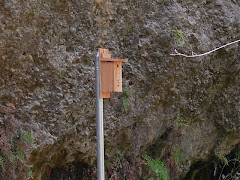
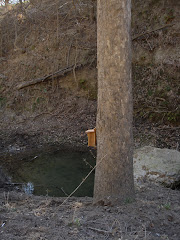
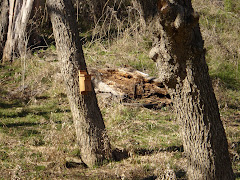
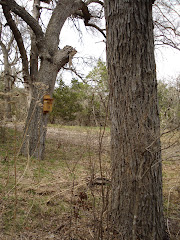
This will be the last post for this site do to a change in emphasis in my bird research at Pedernales Falls State Park. In March 2009 I will be begin a Breeding Bird Survey as apposed to just a Prothonotary Warbler Nest Box Study. Nest boxes are still in place and will continue to be monitored for activity.
Please click on the link to the right: Pedernales Falls State Park Breeding Bird Survey 2009, to stay up to date with sightings for this year's breeding bird season.
Tuesday, February 24, 2009

Sunday, February 8, 2009
Pipeline Trail & Bird Blind
 February is my free month before starting the second year of a Breeding Bird Survey at Pedernales Falls State Park. So this month I am taking the opportunity to do some strength training with a 30 pound backpack on for a May ascent of Mt. Shasta in Northern California. This training involves hiking the pipeline right of way. The park manager says this is the most rigorous hike on the property. It is almost 2 miles long and goes through a series of three hills. All in all, it is quite the workout and having telescoping hiking poles really helps stabilize oneself in steep loose rocky terrain. We actually hiked past the distant horizon shown in the photo photo above.
At the bird blind there were no new arrivals only the usual year-round residents, and one fox sparrow, a white-throated, several Lincoln's, and several House sparrows, plus a Dark-eyed Junco, a few Pine Siskins, as well as Lesser and American goldfinches. Down at Hackenberg Creek I spotted Ruby-crowned Kinglets, several Yellow-rumped Warblers, a Red-shouldered Hawk and a Spotted Sandpiper. Overcast skies graced this day along with strong winds at the park but temperatures did reach the 70's. Not bad at all for a February day!
Saturday, January 31, 2009
Sunny Day Nest Box Repairs & Site Visits
 A gorgeous day in Texas Hill Country to enjoy a bit of nature at Pedernales Falls State Park. Today Bill McDaniel, park manager, helped me install all ten nest box fronts back to their original sites along the Pedernales River and Twin Falls.
At Hackenberg Creek nest boxes 7 & 8 were moved down from the grassy plateau to the edge of the Pedernales River and placed on Bald Cypress trees. Nest box 4, at Trammel Crossing, was relocated onto a Hackberry tree slightly closer to the river, and at Tobacco Creek nest box 6 was moved from a grassy plateau down to an island mounted on a  Bald Cypress. It was here where we walked upon a mature Bald Eagle perched along the river at the top of a cypress tree. This bird was very tolerant of our presence and remained perched for a good ten minutes before our close approach caused it to fly upstream. We wondered if this was a nesting adult and where its nest might be or whether it was a winter vagrant.
All the nest boxes are in place now with new, larger openings routed out by one of the park staff - Blake Gayler. I believe these boxes are in place in time for even the year-round resident birds to make use of as they can begin nesting earlier than those that migrate. With the new size openings at 1-1/2" wide by 2" tall we could see activity by the Carolina Chickadee, wren species, the Black-crested Titmouse, and perhaps a woodpecker. Of course I am still hopeful to attract a Prothonotary Warbler come April or May.
Many thanks go to Bill McDaniel for helping me resize the nest box openings and gaining vehicular access to my more remote study sites.
Sunday, January 25, 2009
January Nest Box Repairs & Bird Blind Visit
Today I waited until temperatures warmed to the high 40's before venturing out to the park as my plan was to mountain bike to East Park Boundary 3-1/2 miles distant from the Primitive Campground parking lot. Lucky for me I did not have to do that.
I was very fortunate to connect up with Bill McDaniel, park manager, who put me in touch with  Lynn Kuenstler, a State Park Peace Officer. Lynn drove me out to Tobacco Creek and East Park Boundary nest box sites. My aim today was to remove the fronts of the boxes so I can open the entrance holes to 1-1/2" wide by 2+" in height. We also visited Twin Falls nest boxes #1 & 2. At Twin Falls a trespasser gained access to the pool area, pulled one nest box with pole out of the ground and threw it into the deep pool. Lucky the weight of the pole and box did not allow for a far throw, whereby Lynn was able to pull the box out of the pool. I also learned today the location of a Mountain Lion sighting made last Fall at Jones Springs, relatively close to one of my nest box sites.
 Lynn Kuenstler, a State Park Peace Officer. Lynn drove me out to Tobacco Creek and East Park Boundary nest box sites. My aim today was to remove the fronts of the boxes so I can open the entrance holes to 1-1/2" wide by 2+" in height. We also visited Twin Falls nest boxes #1 & 2. At Twin Falls a trespasser gained access to the pool area, pulled one nest box with pole out of the ground and threw it into the deep pool. Lucky the weight of the pole and box did not allow for a far throw, whereby Lynn was able to pull the box out of the pool. I also learned today the location of a Mountain Lion sighting made last Fall at Jones Springs, relatively close to one of my nest box sites.
At the bird blind there were still a couple of Pine Siskins, one Dark-eyed Junco, a White-throated Sparrow and a Fox Sparrow, along with an Orange-crowned Warbler and a Ruby-crowned Kinglet. On the drive out of the park I spotted two Common Ravens soaring high in the sky. I believe this to be a mated pair who will be nesting soon either in a stick nest built in a tree or on a rock outcrop. Ravens mate for life and have a territory approximately 10 square miles or larger. This all depends on food availability.
Saturday, January 3, 2009
Pedernales Falls State Park 2009
Warm temperatures and fair skies brought me out to the park today as I envision a second year of breeding bird surveys along the river at Pedernales Falls State Park in Blanco County. I will be surveying all ten nestboxes, and recording all birds seen and heard at each location. Nestbox openings will be enlarged to an oval shape to accommodate more species, and to make it more inviting for Prothonotary Warblers.
Last year's bird research was setup to attract the Prothonotary Warbler to manmade nestboxes along the river. It is important to point out here that this part of Texas represents the western most range of this species and nesting attempts have been recorded in neighboring counties. However, because I did not see any Prothonotary Warblers during the 2008 bird surveys, the new 2009 study will be renamed to: Pedernales Falls State Park Breeding Bird Survey.
All birds observed and heard for a ten minute period, will be recorded at each nestbox during the breeding season, including nesting activity and fledglings. I expect the surveys will begin mid-March, as this is the time male Golden-cheeked Warblers begin setting up territory, and surveys will end sometime mid-July.
Today at the bird blind a single Fox Sparrow gave an occasional appearance along with a Dark-eyed Junco, two White-throated, several Lincoln's, and one Rufous-crowned sparrow. There were many Pine Siskins and American Goldfinches, plus two Orange-crowned Warblers and the usual year-round residents.
After visiting the bird blind I proceeded to mountain bike the Wolf Mountain Trail for a gorgeous day in the park. Temperatures reached the low 80's. Perfect weather to be biking in this beautiful hill country.
Thursday, November 27, 2008
Pedernales Thanksgiving!
 After the fog burned off this morning, and the sun warmed the countryside, I biked Wolf Mountain Trail where one can find scenic glimpses of the surrounding hillsides. All the oak trees still hold their leaves providing brilliant reds among a sea of rich green junipers.
My visit to the park this morning began at the bird blind where a Fox Sparrow added highlight to my day. Down at Hackenburg Creek and the Pedernales River I saw a Winter Wren who delighted in the gnarly broken branches hung up in the bald cypress trees along the river's edge. This is the same place I saw this species last winter and spring. A Green Kingfisher flitted back and forth across the water, only a foot above its surface, in search of small fish.
 delighted in the gnarly broken branches hung up in the bald cypress trees along the river's edge. This is the same place I saw this species last winter and spring. A Green Kingfisher flitted back and forth across the water, only a foot above its surface, in search of small fish.
Most of the bald cypress have dropped their needles leaving a brown soft mat along the shoreline. Water levels along the river are probably at winter lows. The water flowed lazily by with groups of cypress needles marking its flow rate.
I stopped at Jones Springs where the silence was perfect for meditation. Western Scrub Jays, and an occasional Black-crested Titmouse broke the silence as they came by to bathe and drink. Temperatures reached the mid 70's but with no noticeable wind it felt like 80 degrees. A perfect Thanksgiving Day to enjoy some physical exercise and the sites and sounds of wildlife in the park.
Saturday, October 25, 2008
Fall Sparrows & Old Settlers' Graveyard
Fall in Texas Hill Country could not be nicer! Today, even with a late start at the bird blind, I found six species of sparrow including the first Dark-eyed Junco of the year. Other species included a Field, Vesper, Lincoln's, Chipping, and the Rufous-crowned Sparrow. Four Pine Siskins and several Orange-crowned Warblers were also noteworthy, and Ruby-crowned Kinglets were abuntant in migration today.
I then proceeded to mountain bike across the trammel crossing to the far side of the park where I was in search of an old settlers' graveyard. With a little persistence I found this graveyard near the trail that borders the property with a fence line.
I spent two hours at this cemetery reflecting on the passing of my father one week ago. I came away with no photos for today's journey, only good spirit, love and reverence for all life.
Sunday, September 21, 2008
Mountain Biking & Fall Migrants

 Cool mornings finally speak of Fall in Texas. To celebrate I biked both the trail across the Pedernales River and the Wolf Mountain Trail. At the river, looking back toward the main campground, I saw a roost of both the Black Vultures and Turkey Vultures. They remained on their perch for the entire hour I biked the river crossing trail. These vultures are probably waiting for a few campers to leave the campgrounds so they can go scavange for food scraps. In the photo above right one can see these vultures above the tree line.
Along the river a male Summer Tanager came down for a close look, after I made a pishing sound. I had heard its call notes and wanted one last look at this colorful bird before it left on migration. The Western Scrub Jays were not only vocal but visually abundant, unlike during the  summer months. Migrating Eastern Phoebe's appeared in high and dry locations as well near the water. At the bird blind I saw my first migrant sparrow of the year, a Field Sparrow.
 summer months. Migrating Eastern Phoebe's appeared in high and dry locations as well near the water. At the bird blind I saw my first migrant sparrow of the year, a Field Sparrow.
Stopping at Jones Springs, along the  Wolf Mountain Trail, I found both a Preying Mantis (photo above right), and a young Anole (photo to the left), hanging out on a flowering composite. Both were hunting food. The Mantis found a bee for a meal.
 Wolf Mountain Trail, I found both a Preying Mantis (photo above right), and a young Anole (photo to the left), hanging out on a flowering composite. Both were hunting food. The Mantis found a bee for a meal.
It was a gorgeous day to be out on the trails at Pedernales Falls State Park, plus I met an interesting outdoor nature enthusiast as well!
Saturday, September 13, 2008
Wolf Mountain Biking & the Bird Blind
 I arrived at the park just past sun-up and discovered at the Primitive Camp parking lot not a soul had chanced camping overnight with Hurricane Ike bearing down
 on Houston. I biked under cloudy skies and strong winds along the 7.5 mile Wolf Mountain Trail without crossing paths with anyone except a Fox Squirrel and a few butterflies.
The park is so beautiful under overcast skies when the sun is not zapping water out of every pore of my body on these hot, humid, late Summer days. There really are some
 nice vistas along the trail, as well as bike balancing acts traversing rock fields along the way. I usually opt to get off my bike and walk through some of these
 areas.
At the bird blind I found one migrant male Ruby-throated Hummingbird along with the usual resident birds. This blind really is layed out nicely with the water structures at the back of the enclosed feeding area.
Monday, September 1, 2008
Bird Blind & Pedernales River Sitings
 This morning I was hoping to see some migrant birds at the bird blind. The only migrant was a juvenile Baltimore Oriole. There has been an albino-crested female Northern Cardinal hanging out at the bird blind since July. Photo to the left.

White-eyed Vireos were singing incessantly both at the bird blind and down by the river.
On the Pedernales River at Hackenburg Creek, I had a Western Cottonmouth Snake swim upstream to me. At 15 feet it picked up my scent and turned around heading
 down stream again. I was able to get two photos of this snake. An Eastern Phoebe kept me company for the hour I sat by the river with a nice breeze out of the north. Winds spiraling off of Hurricane Gustav.
Sunday, July 27, 2008
Pedernales River & Bird Blind
Today myself and a neighbor took a leisurely trek to the Pedernales Falls State Park Bird Blind. In addition, I visited one of my nest box study sites, Hackenburg Creek. Just before turning into the Bird Blind we saw about 10 Feral Pigs rooting around along side the road plus a young fawn prancing around the roadside in play. Behind the bird blind along the walkway I heard the Bell's Vireo. Today was the first time I saw Tufted Titmice as well as the usual Black-crested Titmice. I wonder if juvenile Black-crested Titmice do not always have the black crest. There were more than a dozen Northern Cardinals in family groups eating sunflower seeds as well as the abundant House Finch. One of the juvenile Cardinals appears to have white feathers coming in on its head.
We spent several hours picnicking down at the confluence of Hackenburg Creek and the Pedernales River. There I watched closeup a male Green Kingfisher perch above me. Another individual flew by very quickly, like a bullet. I believe there are at least two pair of Green Kingfishers nesting along the river in the park. A pair of Summer Tanagers later perched above making a burry contact call for over 20 minutes in the big Bald Cypress tree. Turkey Vultures came down to drink from the rivers edge as did two White-tailed Deer.
I see no breeding bird activity taking place at the end of July in the middle of this hot Texas summer. Bird Blind volunteers reported less than half an inch of rain this past week from the recent Dolly Hurricane. Water levels on the Pedernales River remain low.
Saturday, July 19, 2008
July Full Moon Birding
 On the drive into the park I saw perched two Common Ravens silhouetted against the early morning sky and I heard a Rufous-Crowned Sparrow and a Common Nighthawk singing/calling. A Jack Rabbit greeted me at the Primitive Campground parking lot.
I arrived too late for a "Full Moon" bikeride but I managed to survey Tobacco Creek and East Park Boundary before the heat intensified. There was a noticable absence of songsters today especially during my bikeride along four miles of trail. In fact, there were more contact calls in the woods than anything else. New observations included a Chimney Swift and Cliff Swallows flying along the Pedernales River. This was the first time I did not hear any juvenile Red-shouldered Hawks squawking.
I finished out the morning at the bird blind where there were numerous Northern Cardinals and House Finches. A single Lark Sparrow along with female and juvenile Black-chinned Hummingbirds and Painted Buntings were also seen.
Water levels in the river are the lowest I have seen this year. The photo is of the only grassy part of the Wolf Mountain Trail that I ride near the east park boundary. Bird watching at the park appears to be done until Fall Migration begins.
Saturday, July 5, 2008
Final Bird Survey of the Year
 Rufous-crowned Sparrows were out in force this morning. I heard them singing before sunrise along with Common Nighthawks and Chuck-will's Widows from the Park Office (sunrise photo). A Rufous-crowned Sparrow continues to claim territory above Twin Falls.
I still have a Louisiana Waterthrush on territory along Twin Falls Creek and the nesting Blue Grosbeaks now have fledged young. The other nest I was following is the Acadian Flycatcher nest #2 at Tobacco Creek Seep. There is one nestling which both parents are feeding. I believe this young will be fledged within the week. I also saw one Acad ian Flycatcher fledgling from nest #1, along with an adult in the Tobacco Creek drainage.
 ian Flycatcher fledgling from nest #1, along with an adult in the Tobacco Creek drainage.
At nest box #4 early in the morning I watched a Skunk rooting around and finally retire for the day in its den at the lower right base of this Live Oak tree root (photo). Directly after the skunk observation, I heard rustling in the grasses downhill. Two Armadillos were running around the  hillside playing. I thought for a moment I was contending with wild pigs.
 hillside playing. I thought for a moment I was contending with wild pigs.
Throughout the rest of the year I will continue to mountain bike and bird watch at Pedernales Falls State Park. However, I may only be visiting once or twice a month. Stay tuned as I will post any wildlife encounters.
The plant photo is Caster Bean, cultivated in Texas for its oil and as an ornimental. The plant is native to Ethiopia and all parts of the plant are poisoness. It is common along Twin Falls Creek. It grows near the water and can reach 5' tall. It has a cockle bur-like seed. Saturday, June 28, 2008
Summer Bird Songs Waning
 My experience with Breeding Bird Censuses are most birds are identified by song. However, as the breeding season progresses I am detecting more birds by visual ID. Today that threshold has been reached. There really were not a lot of birds singing, a product of fledged young and moving family units. White-eyed Vireos continue to be vocal along with a few Painted & Indigo Buntings. Golden-cheeked Warblers have been quiet for two weeks now, yet I still see individuals at Twin Falls.
I did hear for the first time on this survey an Eastern Wood Pewee singing at Tobacco Creek and another bird sited at East Park Boundary. The Acadian Flycatcher nest #2 at Tobacco Creek Seep was still active with a female  flying onto the nest as I arrived. By now this bird should have young. The Blue Grosbeak nest at the Twin Falls and Pedernales River location has two 14 day old young in the nest. Photo above right. Both parents were actively feeding them. One Rufous-crowned Sparrow continues to sing at Twin Falls.
 flying onto the nest as I arrived. By now this bird should have young. The Blue Grosbeak nest at the Twin Falls and Pedernales River location has two 14 day old young in the nest. Photo above right. Both parents were actively feeding them. One Rufous-crowned Sparrow continues to sing at Twin Falls.
I walked upon a Rock Squirrel, near Tobacco Creek. It was in no hurry to hide so I was able to take some photos of it resting on a rock and taking a dust bath. Looks like I have one more week of surveying to follow-up on the two active nests. I hope to be back the Fourth of July.
Sunday, June 22, 2008
Webberville Co. Park Nesting Prothonotary
 Today I traveled to Webberville County Park for a first hand look at nesting habitat of a Prothonotary Warbler along the Colorado River. I was following up on a Texbirds report by Cullen Hanks of a nesting Prothonotary Warbler at the boat dock. This park has lots of tall Hackberry, Pecan, Cedar Elm, and Box Elder trees, including an abundance of Poison Ivy shrubs and vines. The trees and shrubs form a dense corridor of forest along the rivers edge. I began my search 9:30 A.M. looking over the sign posts, where the bird was reportedly nesting in the vicinity of the boat launch. I soon found out the young had already fledged the nest. I discovered the adult male actively singing NE of the boat launch site up until the time I left at 12 noon.

After about an hour of hearing the bird and only two glimpses of it flying across the river, I finally decided to hike into the forest, into the dense poison ivy underbrush, where I watched the male 25' away along the rivers edge. I observed this bird for an hour preen, sun its black tipped tail feathers, and feed itself and one fledgling, all within 15' of the ground and the waters edge.
Now that I have first hand evidence of Prothonotary Warbler habitat in central Texas I can say there is slim probability this species will nest along the Pedernales River in Pedernales Falls State Park. However, the data I am collecting falls into the category of a Breeding Bird Census which I intend to continue in 2009. I will also continue monitoring the nest boxes.
 I will also continue monitoring the nest boxes.
This year all ten nest boxes I put up at Pedernales Falls State Park, did not attract a single avian nester. However, at my home in Oak Hill I did have a Bewick's Wren nest with a 1-1/4" diameter opening similar to the nest boxes at the park. After contacting Chuck Jones, sanctuary manager at the Heard Wildlife Sanctuary, where a Prothonotary successfully nested last year, I learned the nest box opening should be 1-1/2" not the 1-1/4" I designed for.
So next year I plan to change the cavity entrance to 1-1/2" on all ten nest boxes. The only downfall for providing a larger entrance is this will allow the Brown-headed Cowbird to enter and lay its eggs. This years surveys I have reported the presence of cowbirds at all nest box locations.
To better identify this research project I will be changing the name of my blog site in 2009 to Pedernales BBC, (Breeding Bird Census) or something similar. Some of the nest boxes I intend to relocate lower to the river. If you have suggestions regarding this study please contact me at andres.susan@gmail.com.
Photos provided are of the sign posts at Webberville County Park. At this time I am not sure which post the Prothonotary Warbler actually nested in. All the posts have no cap on the top of the pole which is apparently where the bird entered and built its nest.
Saturday, June 21, 2008
Birding the Summer Solstice
 A waning gibbous moon and Jupiter greeted me on my drive to Pedernales Falls State Park this morning. At 5:30 A.M. at the primitive campground parking lot a pair of Screech Owls were calling. I biked the Wolf Mountain Trail to one of my survey sites following my moon shadow. There were quite a few Chuck-will's Widows calling and a few Common Nighthawks. At one point I startled a Chuck Will's Widow from a perch over hanging the trail. It took flight and flew five feet above me for about fifty feet. I had an avian escort flying silently like an over sized butterfly.
The dawn bird chorus at Tobacco Creek was so complete today it was hard to discern all but the loudest singing birds.
Acadian Flycatcher nest #2 is still active with an adult sitting tight at the Tobacco Creek Seep. Today is the first day I did not hear any Golden-cheeked Warblers sing, however I did see one individual along Twin Falls Creek. I suspect the nesting season may soon be over for this species.
There is a female Green Kingfisher hanging around Twin Falls. This individual
 could be nesting somewhere on the steep sloped ridges. The Blue Grosbeak nest at Twin Falls and the Pedernales River has two nestlings about six days old. (Photo to right)
I still hear a male Northern Parula warbler singing at Hackenburg Creek. I also heard for the first time there an Acadian Flycatcher singing its characteristic "Pizza" song!
The Summer Solstice is here (photo above) and breeding birds continue to take advantage of the long days in spite of the heat.
Saturday, June 14, 2008
Blue Grosbeaks & Buntings
 Blue Grosbeaks, Painted Buntings and Indigo Buntings were the most common songsters in the park today as summer brought nearly 100 degree temperatures. Today I found male Blue Grosbeaks singing at three sites. The Twin Falls & Pedernales River Blue Grosbeak nest still has the female sitting on two eggs. The song of this species is similar to the Painted Bunting but hoarser. Rufous-crowned Sparrows continue to be heard along Wolf Mountain Trail and one was recorded on the bluff at Twin Falls this morning.
Walking into Tobacco Creek I passed the Acadian Flycatcher nest #1. It appears the single nestling fledged. I heard the male singing in the draw. At Tobacco Creek Seep I discovered a second active Acadian Flycatcher nest. This nest is located on the same pecan tree limb overhanging the seep that the Black-chinned Hummmingbird nest was on. The hummingbird nest was predated on by a squirrel over a month ago. I watched the female Acadian Flycatcher fly into a leafy area so after my survey I investigated and found the female on the nest. Acadian Flycatcher nests appear to be located on the lower canopy of mature trees, thus quite visible, although they are the same size as the abundant ball mosses.
 The seep at Tobacco Creek continues to bring fresh water dripping off old logs, (photo to the left). Today Red-eyed Vireo, Carolina Chickadees, the Acadian Flycatcher and Painted Buntings frequented this seep. The photo above is one of the easier climbs down to the Pedernales River at Tobacco Creek.
Sunday, June 8, 2008
Bell's Vireo & Brown-headed Cowbird Egg
 After verifying which egg was the Brown-headed Cowbird's I returned today to remove it from the Blue Grosbeak's nest. The cowbird's egg, pictured here, has speckling on it, and lucky for me the grosbeak's eggs are pale blue/white, an easy distinction in this case. Cowbird nestlings typically out-compete their smaller nest mates for food. This species has increased it's numbers in North America thanks to forest clearing creating more edge for it to search out host nests. So wherever there are threatened species nesting, cowbirds are being actively trapped and nests monitored to remove these eggs.

I started out this morning at the Bird Blind where I saw all the usual nesters, however, in the scrubby patch of land adjacent to the trail I heard a Bell's Vireo. Its song matched my recordings, very fast and bubbly like a House Wren. Later two Bell's Vireos came to the oak tree along the open edge of the bird blind. This is a new species for me in the park. It likes shrublands that include willows and streamsides.
I also verified that the Lark Sparrows are tending young in the nest. Viewing the nest from below, it is rather camouflaged to the human eye.
Saturday, June 7, 2008
Acadian Flycatchers & Coral Snake
Overcast skies made today's survey more bearable. As summer settles in it appears the Acadian Flycatchers decided to move in as well. What I thought was one male on territory at Tobacco Creek turned out to be two, one at Tobacco Creek and the other at the Seep. I discovered an Acadian Flycatcher nest 25 feet up in a mature Hackberry tree along the Tobacco Creek ravine. It appears to be made of fine roots and is easy to mistake for a ball of moss hanging on tree branches. I saw the male feed one, almost grown, nestling. At East Park Boundary I found another male Acadian singing for the first time there.
 On my hike into East Park Boundary I startled a Coral Snake along the side of the path. I watched it slither under a rock. The Coral Snake is very colorful and shiny. This is the second venomous snake I have found at Pedernales Falls State Park, the first being a Western Cottonmouth. I have yet to see a Rattle Snake here. At the mouth of Twin Falls Creek I took this photo of the Blue Grosbeak nest. The smaller speckled egg was laid by a Brown-headed Cowbird, a brood parasite.

 On my hike into East Park Boundary I startled a Coral Snake along the side of the path. I watched it slither under a rock. The Coral Snake is very colorful and shiny. This is the second venomous snake I have found at Pedernales Falls State Park, the first being a Western Cottonmouth. I have yet to see a Rattle Snake here. At the mouth of Twin Falls Creek I took this photo of the Blue Grosbeak nest. The smaller speckled egg was laid by a Brown-headed Cowbird, a brood parasite.

Today I wrote up my notes at Pedernales Falls parking lot. There I watched fledged Cliff Swallows perch on a utility line. I also discovered a Lark Sparrow nest in the lowest most branch of a juniper tree near the restrooms. The parents did not tarry at the nest when delivering food. I do not know whether this behavior is normal or because of frequent human disturbance.
The photo above is a bat I found laying dead on the trail to Twin Falls. I guess this bat to be the Mexican Free-tail. One final note, I heard several Rufous-crowned Sparrows singing along the Wolf Mountain Trail. It appears these fellows enjoy the start of summer also.
Saturday, May 31, 2008
Lazy Summer Day & Breeding Birds
 Six A.M. 67 degrees with overcast skies as I biked to East Park Boundary. I wish I camped overnight as it would have been perfect sleeping weather out here. The Common Nighthawks were doing their display dive.
Though many birds have fledged young, like the year round residents, there are a fair number of late migrants who are still on eggs or feeding nestlings at this time. I saw a Summer Tanager Thursday carry a large white grub away to the nest. Today I saw a female Golden-cheeked Warbler eating insects rather urgently. I believe she left the nest with eggs to fuel herself.

There are three vireo species nesting along the river: the White-eyed Vireo, Yellow-throated Vireo, and Red-eyed Vireo. The White-eyed Vireo arrived a couple weeks earlier than the other two species so one can see and hear many family groups moving around. The Yellow-throated Vireo really likes to hang out in the Bald Cypress trees along the river. Painted Bunting males on territory can be heard just about everywhere in the park, and Indigo Buntings can be found in lesser numbers along the river. The Blue Grosbeak female was adding her finishing touches to the nest I found on Thursday.
The Acadian Flycatcher finally made its appearance to the Tobacco Creek Seep half way through my survey there. It sang and made a twittering sound while flicking its wings. I believe this male
 has a mate sitting on eggs somewhere. This individual has been sited here the entire month of May.
The flower photo is the Twisted Leaf Yucca which is blooming abundantly throughout the Hill Country right now. I added the second Yucca photo to show when the blooms fall off of the tall flowering stalk they get impaled on the pointed leaves below. At the end of every survey I settle down to writeup my field notes. When my last site is Hackenburg Creek I take advantage of the Bald Cypress shade along the river.
Subscribe to:
Posts (Atom)