Prothonotary Warbler Occurrence In Texas

Central Texas draws the western line for the Prothonotary Warbler range. This species occupies much of eastern North America up to the southern boarder of Ontario Canada.
Prothonotarys' nest in natural cavities but also readily use nest boxes located on or near water. Flooded swamps represent ideal habitat but they will also nest along rivers or small bodies of water.
In May 2007 I saw a brightly colored male Prothonotary Warbler at Pedernales Falls State Park bird blind. After some research I learned male birds have been seen building nests in neighboring counties to Blanco County. Further research revealed a pair of Prothonotary Warblers successfully nested at Heard Wildlife Sanctuary in McKinney, Texas.
In December 2007 I decided to undertake a nest box study at the park. January through February 2008 I hiked the entire Pedernales River and tributaries within park boundaries, in an effort to choose the best sites. Habitat selection proved a challenge do to high flood levels along the river.
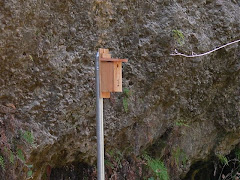
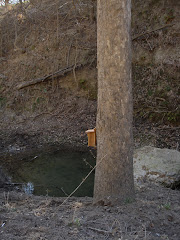
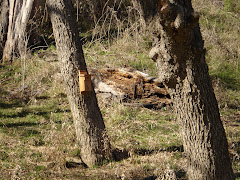
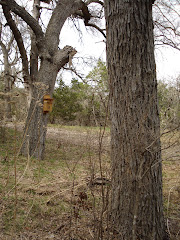
Five sights were eventually selected where two nest boxes each were placed. Most boxes were attached to trees however two were attached to metal poles. These boxes were monitored from March through June 2008 on a weekly basis. A Breeding Bird Study was conducted at each nestbox location in 2008 and will be continued in 2009.

Saturday, May 31, 2008

Lazy Summer Day & Breeding Birds

Six A.M. 67 degrees with overcast skies as I biked to East Park Boundary. I wish I camped overnight as it would have been perfect sleeping weather out here. The Common Nighthawks were doing their display dive.
Though many birds have fledged young, like the year round residents, there are a fair number of late migrants who are still on eggs or feeding nestlings at this time. I saw a Summer Tanager Thursday carry a large white grub away to the nest. Today I saw a female Golden-cheeked Warbler eating insects rather urgently. I believe she left the nest with eggs to fuel herself.
There are three vireo species nesting along the river: the White-eyed Vireo, Yellow-throated Vireo, and Red-eyed Vireo. The White-eyed Vireo arrived a couple weeks earlier than the other two species so one can see and hear many family groups moving around. The Yellow-throated Vireo really likes to hang out in the Bald Cypress trees along the river. Painted Bunting males on territory can be heard just about everywhere in the park, and Indigo Buntings can be found in lesser numbers along the river. The Blue Grosbeak female was adding her finishing touches to the nest I found on Thursday.
The Acadian Flycatcher finally made its appearance to the Tobacco Creek Seep half way through my survey there. It sang and made a twittering sound while flicking its wings. I believe this male has a mate sitting on eggs somewhere. This individual has been sited here the entire month of May.
The flower photo is the Twisted Leaf Yucca which is blooming abundantly throughout the Hill Country right now. I added the second Yucca photo to show when the blooms fall off of the tall flowering stalk they get impaled on the pointed leaves below. At the end of every survey I settle down to writeup my field notes. When my last site is Hackenburg Creek I take advantage of the Bald Cypress shade along the river.

Thursday, May 29, 2008

Nesting Blue Grosbeaks & Nest Box Updates

Today was a treat being out at the park surveying breeding birds during the week. The campground and trails were quite peaceful with few visitors. Once again I had Common Nighthawks active through mid morning. The highlight was finding a pair of Blue Grosbeaks building a nest near the Pedernales River and Twin Falls Creek. This male is a first year bird with only a blue head.
I found the Rufous-crowned Sparrow for the second week in a row along Wolf Mountain Trail at the location pictured with my mountain bike. This sparrow has a beautiful song. The flowering Yucca is a Twisted leaf Yucca in bloom and visible along many roads in the Texas hill country.
Today I opened each nest box to see what critters were occupying them. They almost all turned out to be in the Insect order, other than one Arachnid.
A wasp species was found in six nest boxes, three boxes were entirely empty, three had the Organ-Pipe Mud Dauber Wasp, and one had Cock Roaches. The Mud Dauber is docile. It paralyzes a spider, places it in a vertical mud cylinder, then lays an egg never to return to the nest.
The Acadian Flycatcher is still present at Tobacco Creek. There are four species of warbler nesting along the river at nest box sites, the Louisiana Waterthrush, Black & White Warbler, Northern Parula, and Golden-cheeked Warbler. Water levels in the Pedernales River continue to drop from lack of rain. I snapped this photo, a tranquil river scene from East Park Boundary.

Saturday, May 24, 2008

Tobacco Creek Seep

Summer heat and lack of rain have lowered the water levels in the Pedernales River. Bee Creek crossing on Wolf Mountain Trail usually has water but for the first time this year it is dry.
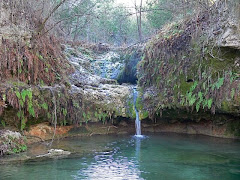
I arrived at Hackenburg Creek by 6:20 AM. Only four bird species were singing. By 8 AM I arrived at the Tobacco Creek Seep nest box 5. In the bird world this is the corner station, only instead of gasoline, water is being served. I saw the following families: White-eyed Vireo, Northern Cardinal, Carolina Wren, Carolina Chickadee, and the Louisiana Waterthrush (2 adults and 1 fledgling) come for drinks. I also saw a beautiful male Golden-cheeked Warbler come down to bathe.
I was also greeted by a male Acadian Flycatcher singing loudly: PEET-ssah. This species hawks insects from the middle canopy so seeing it on territory is relatively easy. I was surprised to hear a Great-crested Flycatcher at site 6. On my bikeride today I stopped to identify, visual and audio, a Rufous-crowned Sparrow. At East Park Boundary I had a fledgling Louisiana Waterthrush approach within 20 feet of me. It was rather curious. The Green Kingfisher gave me a fleeting glance as it bolted upstream. I also saw an Orchard Oriole singing atop a cypress tree along the Pedernales River and a new born fawn could be heard crying for its mother across the river.
At my final nest box site #4, I saw a male and female Blue Grosbeak. This guy was a first year male with blue mostly confined to its head. To finish the day I cooled off in the Pedernales River like many other people did.
On my hikes today I noticed a new creature to contend with, this huge spider who spins its web across trails. Lucky for me I have a birder's eye.

Sunday, May 18, 2008

Yellow-billed Cuckoos & More Fledglings

At 6:30 A.M. on my walk into Twin Falls I heard a Chuck-will's Widow calling near the campgrounds. Along Twin Falls Creek the Louisiana Waterthrush was singing constantly, signaling this pair is still nesting. I watched a Raccoon crawl down a sapling along the cliff adjacent to Twin Falls. It saw me and was running away. At nest box 3 I watched a Broad-winged Hawk briefly land in the Sycamore tree where I was standing.
I actually saw the first Yellow-billed Cuckoo Saturday morning at the main office, and today I heard this species in two locations in the park.
Nine thirty in the morning a Common Nighthawk was flying the skies over Wolf Mountain calling. It is unusual to have this species flying during the day but it is breeding season and these guys came back a little late this year.
The fledglings of the day were three Louisiana Waterthrushes one found at East Park Boundary and two at Tobacco Creek. They were very vocal following adults along the edge of the Pedernales River and Tobacco Creek locations. Also, for the third week in a row at Tobacco Creek, I found the Acadian Flycatcher on territory. No new nests have been found but there are plenty more fledglings added to the ranks of life along the Pedernales River.
The sunrise photo was taken at Twin Falls Creek and the Rock Squirrel at Tobacco Creek. To the left are Black Vultures in their usual roost adjacent to the campgrounds.

Saturday, May 17, 2008

Home Schoolers Birding & Navigating

This morning I devoted to teaching Home Schooled Students the basics of bird identification and navigation skills using a compass. At 6:30 A.M. I arrived at the bird blind to fill the various feeders.
Four children arrived at the blind just after 8 A.M. Our Avian friends provided a nice mix of species for viewing. The children learned Northern Cardinals have a crest that sometimes is not raised. Another bird made its bold entrance the Western Scrub Jay. Black-chinned Hummingbirds were numerous at the two sugar water feeders.
The bird blind provided a new view of birds to these children. Even the parents were amazed at how "up-close" the birds were. The children enjoyed the striking facial pattern of the Carolina Chickadee. Black-crested Titmice and a female Painted Bunting were viewed by all. Some children even spotted Yellow Warblers which were feeding in the Mesquite tree above the bird baths. A male and female Brown-headed Cowbird arrived just before we left. The children learned this species is a brood parasite laying its eggs in other birds nests.
On the walk out we stopped by the Chimney Swift Tower to learn about this species special nesting and perching requirements, as well as food preferences. The park now has two Chimney Swift Towers. You can learn how to build your own tower by clicking on this Chimney Swift Tower link.
The morning ended with a Compass Transect Course where the children walked chains in different directions. They also recorded the number of chains between two park roads which will provide some math exercises later on in class.
We finished the morning by hiking down to the Falls to view the impressive rock formations. Thank you Perry, Micah, Malcom and Christian for joining me on this adventure at Pedernales Falls State Park, and thanks to Louis Larrey for help with the transects and to the parents for rising so early! I believe a few children will return to the bird blind and maybe even start a Life List.