Prothonotary Warbler Occurrence In Texas

Central Texas draws the western line for the Prothonotary Warbler range. This species occupies much of eastern North America up to the southern boarder of Ontario Canada.
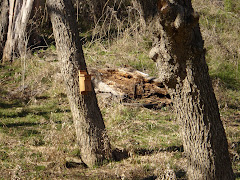
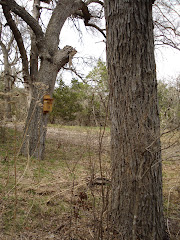
Prothonotarys' nest in natural cavities but also readily use nest boxes located on or near water. Flooded swamps represent ideal habitat but they will also nest along rivers or small bodies of water.
In May 2007 I saw a brightly colored male Prothonotary Warbler at Pedernales Falls State Park bird blind. After some research I learned male birds have been seen building nests in neighboring counties to Blanco County. Further research revealed a pair of Prothonotary Warblers successfully nested at Heard Wildlife Sanctuary in McKinney, Texas.
In December 2007 I decided to undertake a nest box study at the park. January through February 2008 I hiked the entire Pedernales River and tributaries within park boundaries, in an effort to choose the best sites. Habitat selection proved a challenge do to high flood levels along the river.
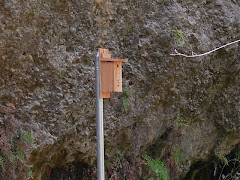
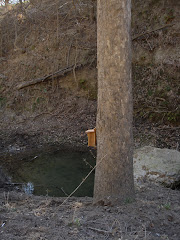
Five sights were eventually selected where two nest boxes each were placed. Most boxes were attached to trees however two were attached to metal poles. These boxes were monitored from March through June 2008 on a weekly basis. A Breeding Bird Study was conducted at each nestbox location in 2008 and will be continued in 2009.

Sunday, May 18, 2008

Yellow-billed Cuckoos & More Fledglings

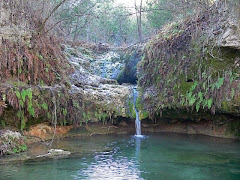
At 6:30 A.M. on my walk into Twin Falls I heard a Chuck-will's Widow calling near the campgrounds. Along Twin Falls Creek the Louisiana Waterthrush was singing constantly, signaling this pair is still nesting. I watched a Raccoon crawl down a sapling along the cliff adjacent to Twin Falls. It saw me and was running away. At nest box 3 I watched a Broad-winged Hawk briefly land in the Sycamore tree where I was standing.
I actually saw the first Yellow-billed Cuckoo Saturday morning at the main office, and today I heard this species in two locations in the park.
Nine thirty in the morning a Common Nighthawk was flying the skies over Wolf Mountain calling. It is unusual to have this species flying during the day but it is breeding season and these guys came back a little late this year.
The fledglings of the day were three Louisiana Waterthrushes one found at East Park Boundary and two at Tobacco Creek. They were very vocal following adults along the edge of the Pedernales River and Tobacco Creek locations. Also, for the third week in a row at Tobacco Creek, I found the Acadian Flycatcher on territory. No new nests have been found but there are plenty more fledglings added to the ranks of life along the Pedernales River.
The sunrise photo was taken at Twin Falls Creek and the Rock Squirrel at Tobacco Creek. To the left are Black Vultures in their usual roost adjacent to the campgrounds.

Saturday, May 17, 2008

Home Schoolers Birding & Navigating

This morning I devoted to teaching Home Schooled Students the basics of bird identification and navigation skills using a compass. At 6:30 A.M. I arrived at the bird blind to fill the various feeders.
Four children arrived at the blind just after 8 A.M. Our Avian friends provided a nice mix of species for viewing. The children learned Northern Cardinals have a crest that sometimes is not raised. Another bird made its bold entrance the Western Scrub Jay. Black-chinned Hummingbirds were numerous at the two sugar water feeders.
The bird blind provided a new view of birds to these children. Even the parents were amazed at how "up-close" the birds were. The children enjoyed the striking facial pattern of the Carolina Chickadee. Black-crested Titmice and a female Painted Bunting were viewed by all. Some children even spotted Yellow Warblers which were feeding in the Mesquite tree above the bird baths. A male and female Brown-headed Cowbird arrived just before we left. The children learned this species is a brood parasite laying its eggs in other birds nests.
On the walk out we stopped by the Chimney Swift Tower to learn about this species special nesting and perching requirements, as well as food preferences. The park now has two Chimney Swift Towers. You can learn how to build your own tower by clicking on this Chimney Swift Tower link.
The morning ended with a Compass Transect Course where the children walked chains in different directions. They also recorded the number of chains between two park roads which will provide some math exercises later on in class.
We finished the morning by hiking down to the Falls to view the impressive rock formations. Thank you Perry, Micah, Malcom and Christian for joining me on this adventure at Pedernales Falls State Park, and thanks to Louis Larrey for help with the transects and to the parents for rising so early! I believe a few children will return to the bird blind and maybe even start a Life List.

Sunday, May 11, 2008

Mothers Day Morning Bird Blind


Most holidays I like to visit a favorite park to observe Nature. Today I visited the Bird Blind at the park. This blind is really a great place to see birds up close. It did not appear the park received the downpour that SW Austin did last night. So many of the birds were enjoying a bath this morning.
A small flock of warblers took advantage of the drip water baths and mister. There were 4 Yellow Warblers, a Wilson's and an Orange-crowned Warbler. I had the best look ever of an Ash-throated Flycatcher. I also saw my first Gray Catbird of the season. Three Lark Sparrows were the only sparrow species reported this morning. They have a striking facial pattern.
I later walked down to the river near the Falls. Soaring west along the river were two juvenile Red-tailed Hawks. One was carrying a Rock Squirrel in its talons. Back at the bird blind again I discovered this Pipevine Swallowtail Butterfly inside the blind and released it. Lucky for this species it is distasteful to birds.

Saturday, May 10, 2008

Nighthawks, Fledglings & Acadian Flycatcher

Six thirty AM I was greeted by a Gray Fox at the Primitive Camp parking lot. Biking on Wolf Mountain Trail I had at least 8 Common Nighthawks combing the skies catching insects and two Chuck-will's Widows calling. Overcast skies kept these dawn and dusk birds active.
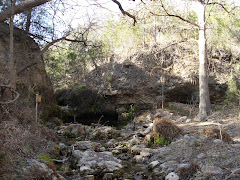
Tobacco Creek is where I began my surveys today. At nest box 5, where there is a seep running down the steep embankment, I watched for 45 minutes an Acadian Flycatcher. The Black-chinned Hummingbird female was tending her nest but not sitting on it. I assume air temperatures were warm enough for her not to be keeping the eggs warm today.

Today many fledglings were begging for food. I found a fledgling Black and White Warbler feeding in its characteristic way of climbing along the trunk of the tree. Blue gray Gnatcatchers and Canyon Wren fledglings were also noted. Carolina Chickadees were traveling around in family groups as well.
Louisiana Waterthrushes appear to be nesting at three locations on my survey route. Each male was singing non-stop during my 20 minute survey time. Temperatures reached 95 degrees today. I see most birds start nesting in April to beat the heat. Hiking and biking under such heat really is exhausting.
All along the forest floor Wood Satyr Butterflies could be seen flying around. These butterflies will lay eggs on grass species for their larvae to feed on.
Todays photos include a Green Anole hunting insects around nest box 3 at Twin Falls Creek. This lizard can change color to match its background. I have already found the anole inside nest boxes. A Diamond Back Water Snake was seen perusing the shoreline at East Park Boundary. I saw two snakes each 3 feet long. These snakes are not poisoness. Finally, I took a photo of this American Rubyspot Damselfly on the Pedernales River where the water moves swiftly.

Saturday, May 3, 2008

Breeding Bird Season At Pedernales

It was a gorgeous day at the park as evidenced by the many visitors to the Falls and the hiking trails. All the deciduous trees appear to be fully leafed out now so there are plenty of caterpillars to go around. Just about every bird I could get my binoculars on was dining on a caterpillar.
Highlights of the day were an Acadian Flycatcher at Tobacco Creek, an Ovenbird and Common Yellowthroat at East Park Boundary, and a Great-crested Flycatcher at Hackenburg Creek.
Northern Waterthrushes appear to be paired and breeding at three locations on my study route. Carolina Chickadees already have fledged young. The female White-eyed Vireo was sitting tight on her nest, and there was no activity at the Black-chinned Hummingbird nest.
I don't hear the song of Summer Tanagers anymore, however, they are present in pairs at all my study sites. Now that they are paired they are using a contact call.
Ovenbirds are a unique warbler that nest on the ground. They have a very distinctive song. They repeat "teacher, teacher, teacher" very loadly. I have found Ovenbird nests in Northern Michigan. They are domed, made of grass, and have a side entrance.
I finally discovered the Rock Squirrels which hang out around the steep rocky slopes along the Pedernales River. They are mostly black with lighter spots on the rump. This is a cool looking ground squirrel as compared to the arboreal Fox Squirrel, the more common squirrel of this area.
The butterfly photo above I believe to be a Little Wood Satyr butterfly.